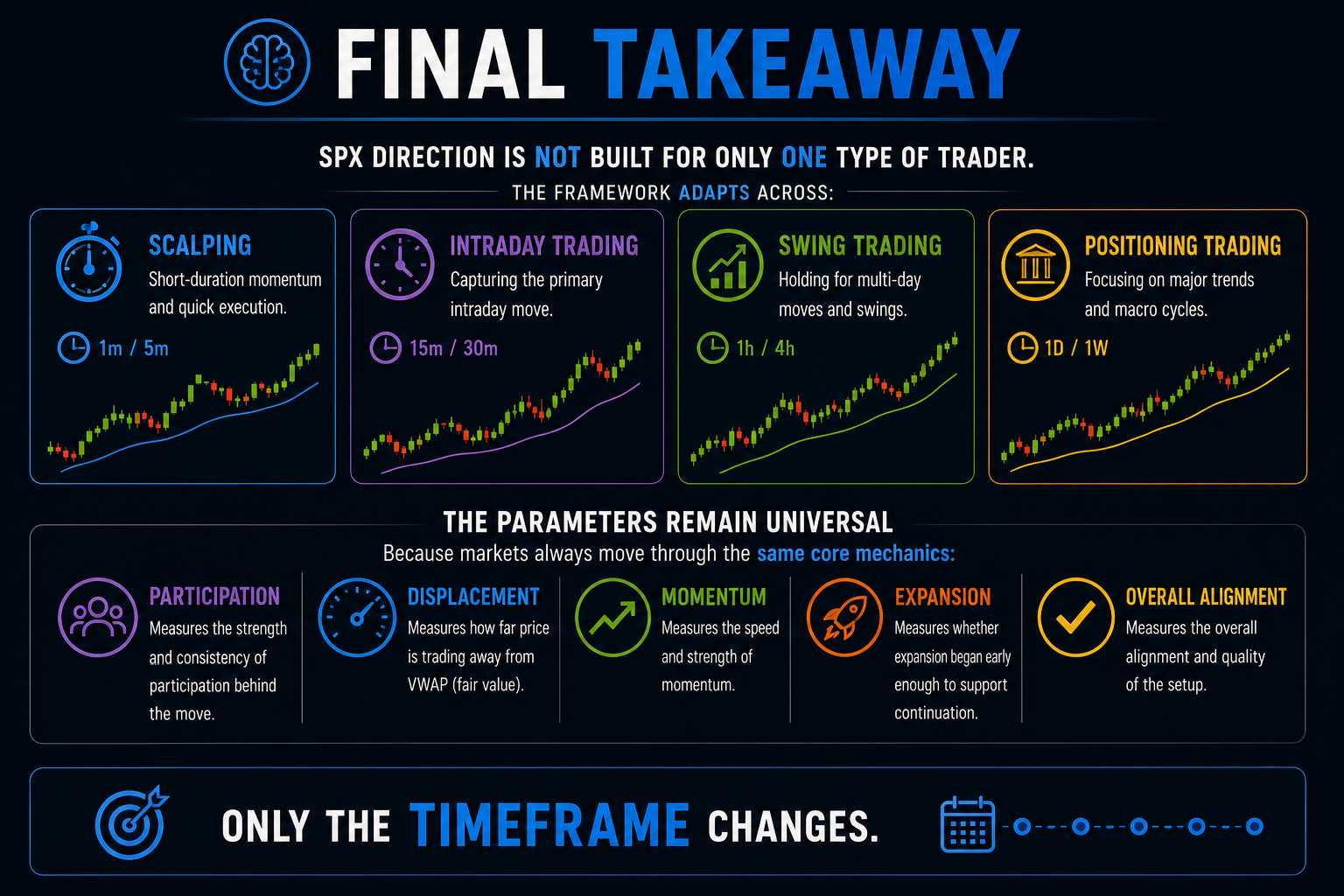
The Four Types of Traders
Contact customer support at support@spxdirection.com
SPX Direction can be used by:
1️⃣ Scalping Traders
2️⃣ Day Traders
3️⃣ Swing Traders
4️⃣ Position Traders
Each trader uses the same concepts differently depending on the timeframe.
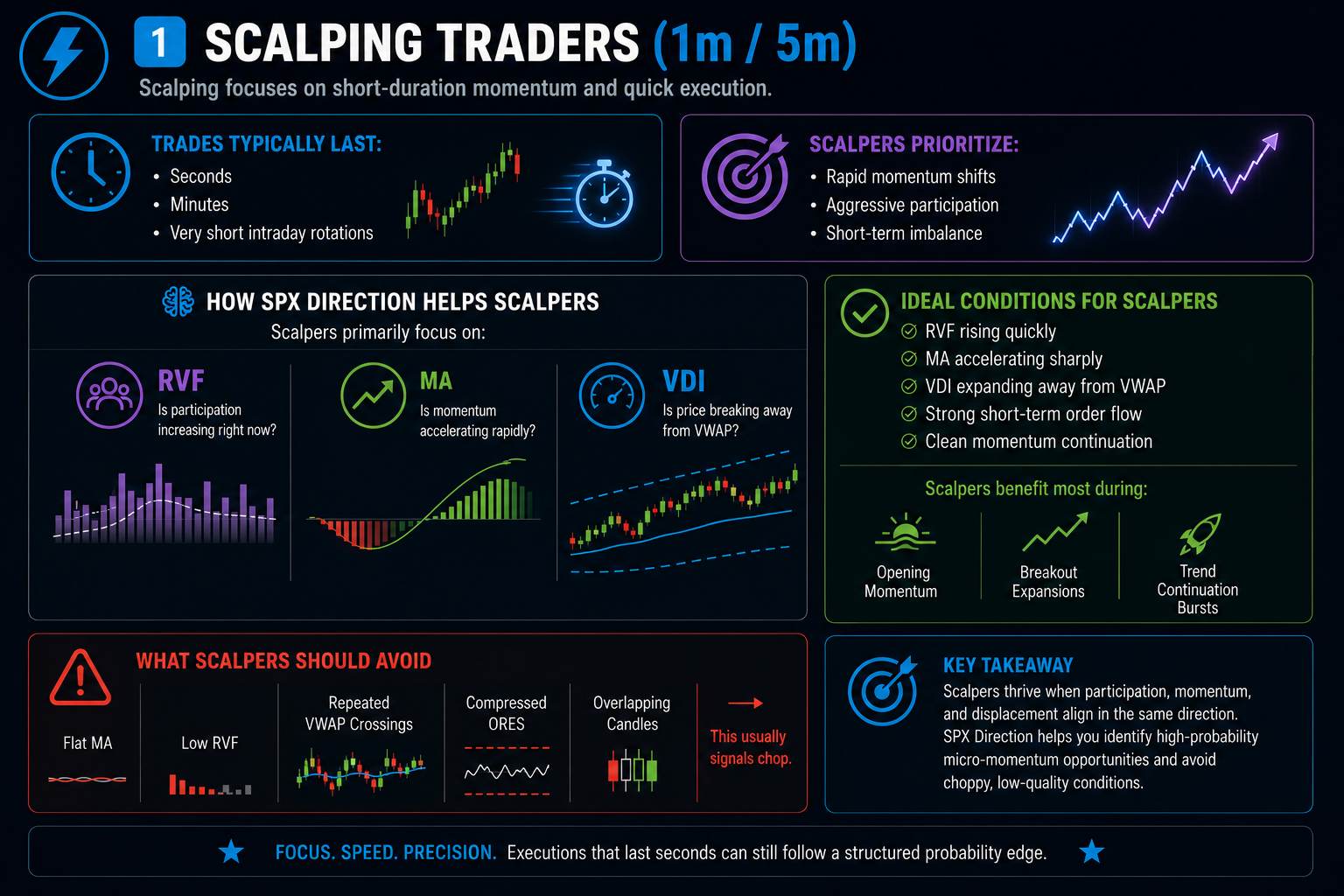
⚡ 1️⃣ SCALPING TRADERS (1m / 5m)
Scalping focuses on short-duration momentum and quick execution.
Trades typically last:
- seconds
- minutes
- very short intraday rotations
Scalpers prioritize:
- rapid momentum shifts
- aggressive participation
- short-term imbalance
🧠 HOW SPX DIRECTION HELPS SCALPERS
Scalpers primarily focus on:
Is participation increasing right now?
Is momentum accelerating rapidly?
Is price breaking away from VWAP?
✅ IDEAL CONDITIONS FOR SCALPERS
- RVF rising quickly
- MA accelerating sharply
- VDI expanding away from VWAP
- strong short-term order flow
- clean momentum continuation
Scalpers benefit most during:
- opening momentum
- breakout expansions
- trend continuation bursts
⚠️ WHAT SCALPERS SHOULD AVOID
- flat MA
- low RVF
- repeated VWAP crossings
- compressed ORES
- overlapping candles
This usually signals chop.
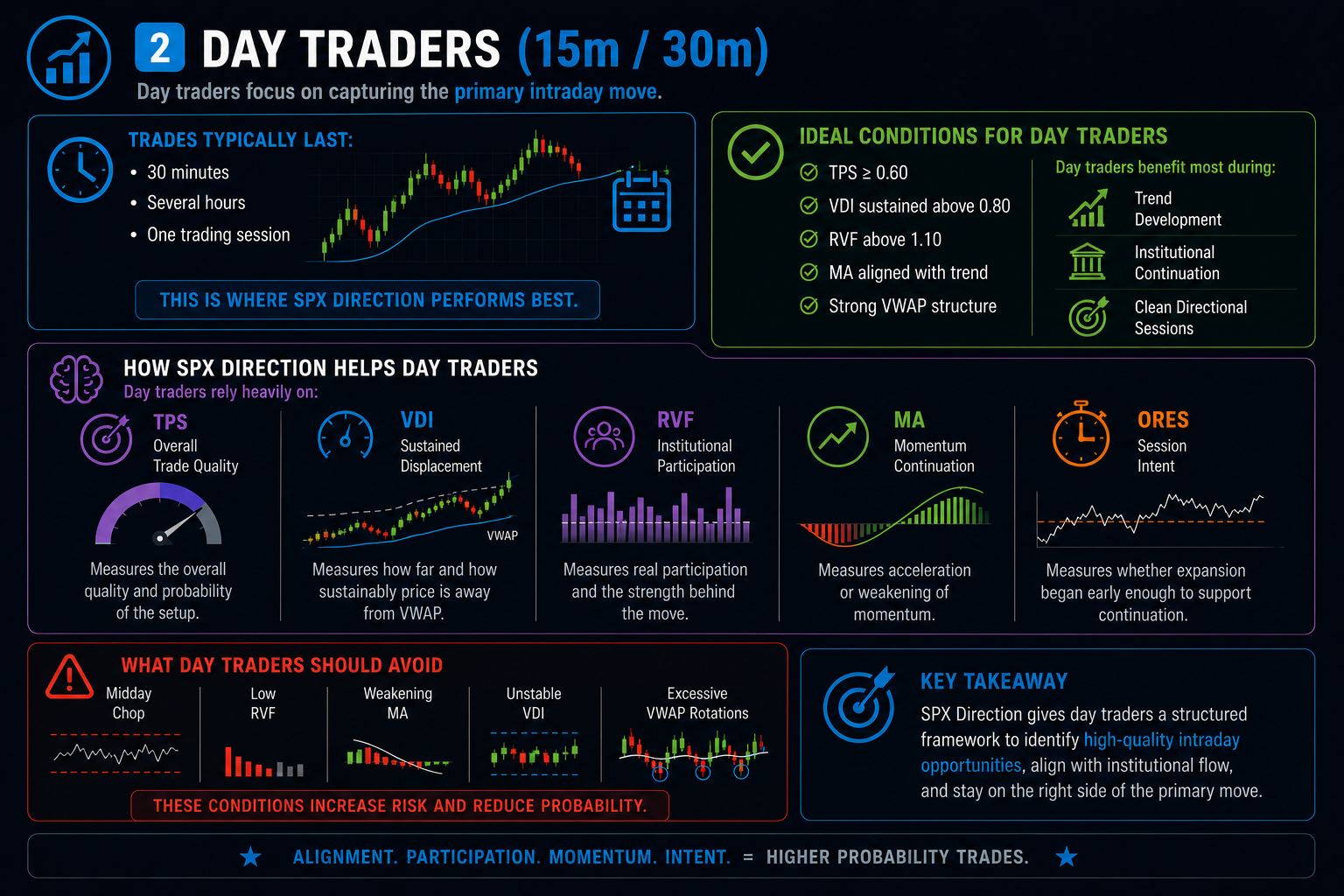
📈 2️⃣ DAY TRADERS (15m / 30m)
Day traders focus on capturing the primary intraday move.
Trades typically last:
- 30 minutes
- several hours
- one trading session
This is where SPX Direction performs best.
🧠 HOW SPX DIRECTION HELPS DAY TRADERS
Day traders rely heavily on:
TPS
Overall trade quality
VDI
Sustained displacement
RVF
Institutional participation
MA
Momentum continuation
ORES
Session intent
✅ IDEAL CONDITIONS FOR DAY TRADERS
- TPS ≥ 0.60
- VDI sustained above 0.80
- RVF above 1.10
- MA aligned with trend
- strong VWAP structure
Day traders benefit most during:
- trend development
- institutional continuation
- clean directional sessions
⚠️ WHAT DAY TRADERS SHOULD AVOID
- midday chop
- low RVF
- weakening MA
- unstable VDI
- excessive VWAP rotations
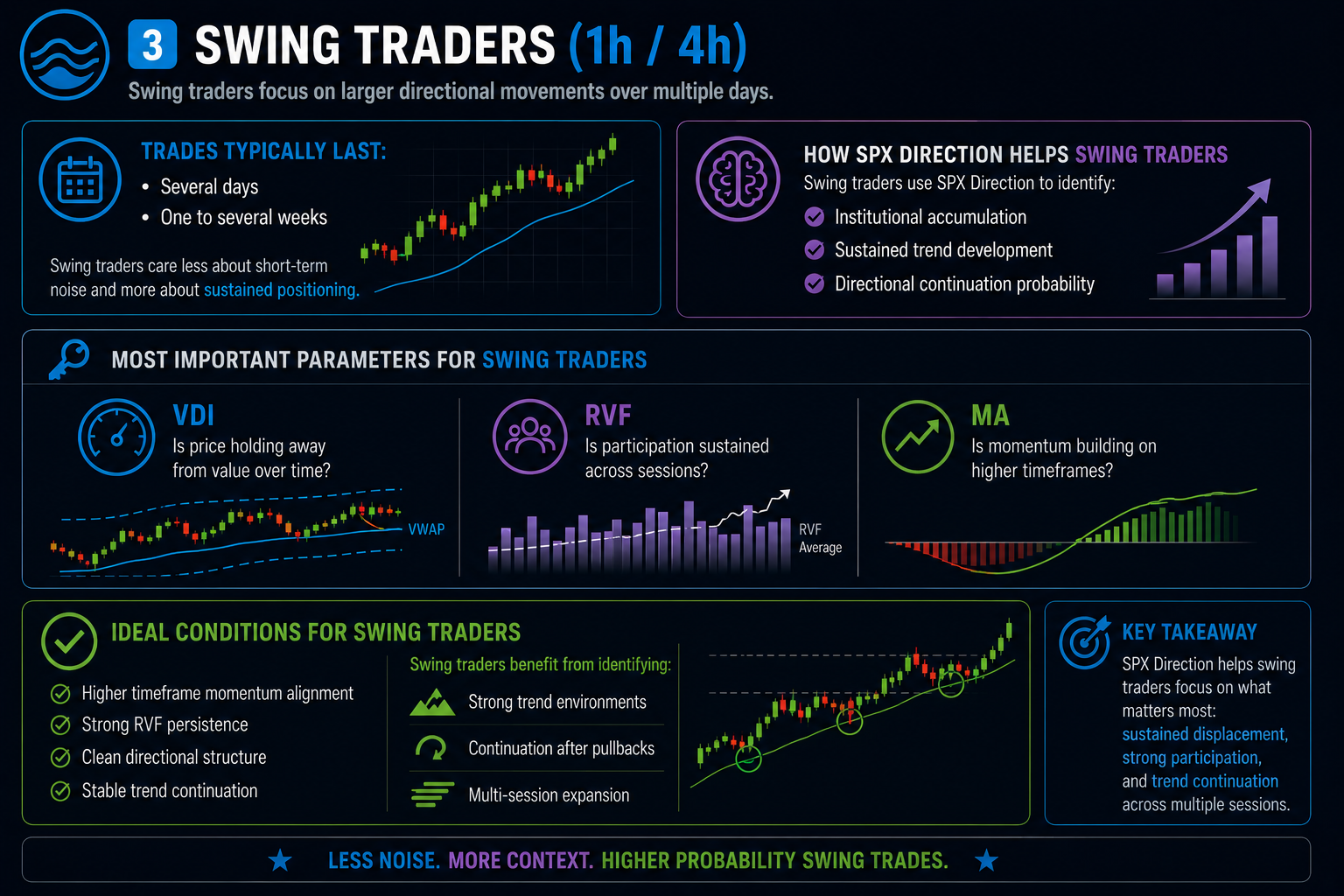
🌊 3️⃣ SWING TRADERS (1h / 4h)
Swing traders focus on larger directional movements over multiple days.
Trades typically last:
- several days
- one to several weeks
Swing traders care less about short-term noise and more about sustained positioning.
🧠 HOW SPX DIRECTION HELPS SWING TRADERS
Swing traders use SPX Direction to identify:
- institutional accumulation
- sustained trend development
- directional continuation probability
🔑 MOST IMPORTANT PARAMETERS FOR SWING TRADERS
VDI
Is price holding away from value over time?
RVF
Is participation sustained across sessions?
MA
Is momentum building on higher timeframes?
✅ IDEAL CONDITIONS FOR SWING TRADERS
- higher timeframe momentum alignment
- strong RVF persistence
- clean directional structure
- stable trend continuation
Swing traders benefit from identifying:
- strong trend environments
- continuation after pullbacks
- multi-session expansion
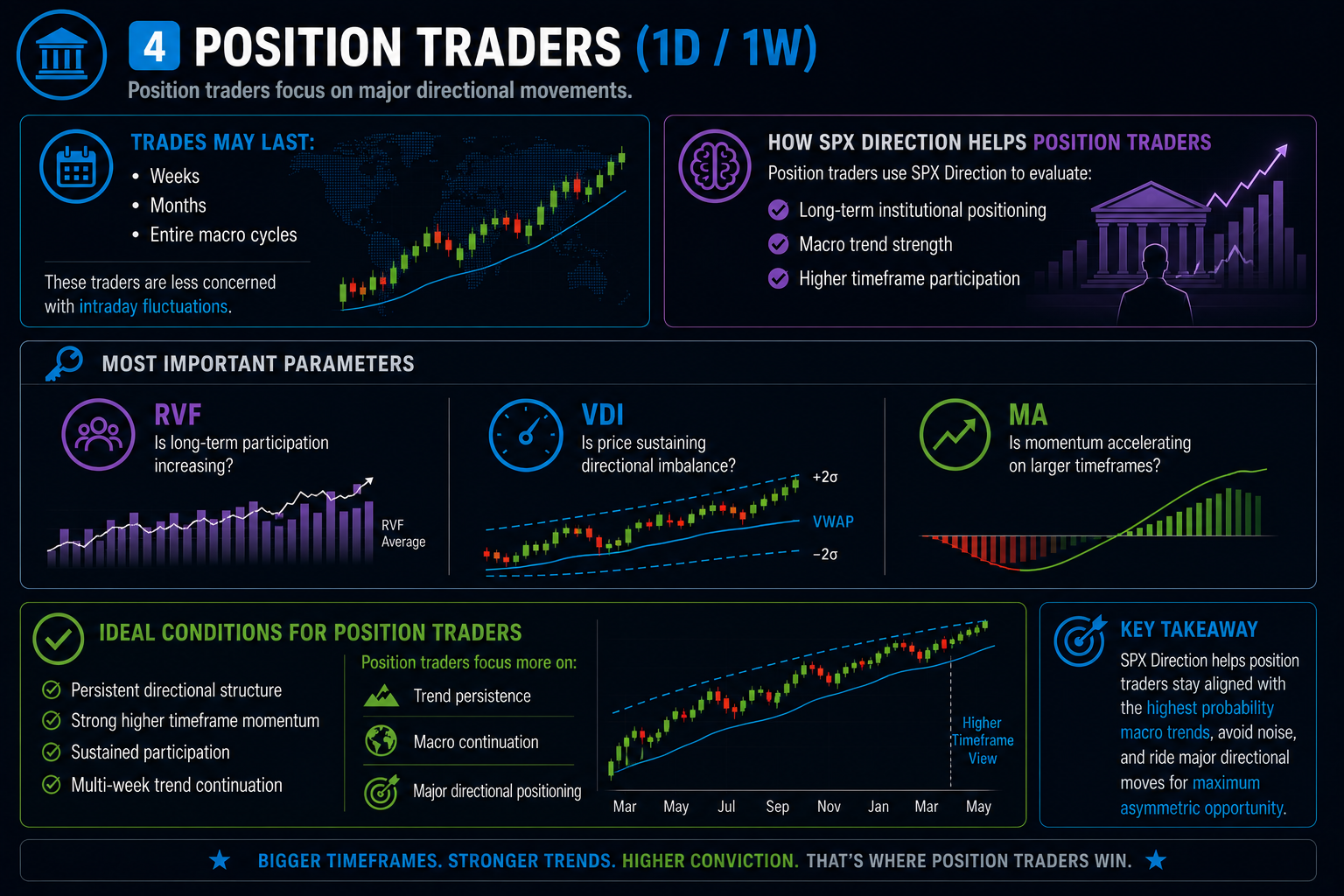
🏛️ 4️⃣ POSITION TRADERS (1D / 1W)
Position traders focus on major directional movements.
Trades may last:
- weeks
- months
- entire macro cycles
These traders are less concerned with intraday fluctuations.
🧠 HOW SPX DIRECTION HELPS POSITION TRADERS
Position traders use SPX Direction to evaluate:
- long-term institutional positioning
- macro trend strength
- higher timeframe participation
🔑 MOST IMPORTANT PARAMETERS
RVF
Is long-term participation increasing?
VDI
Is price sustaining directional imbalance?
MA
Is momentum accelerating on larger timeframes?
✅ IDEAL CONDITIONS FOR POSITION TRADERS
- persistent directional structure
- strong higher timeframe momentum
- sustained participation
- multi-week trend continuation
Position traders focus more on:
- trend persistence
- macro continuation
- major directional positioning
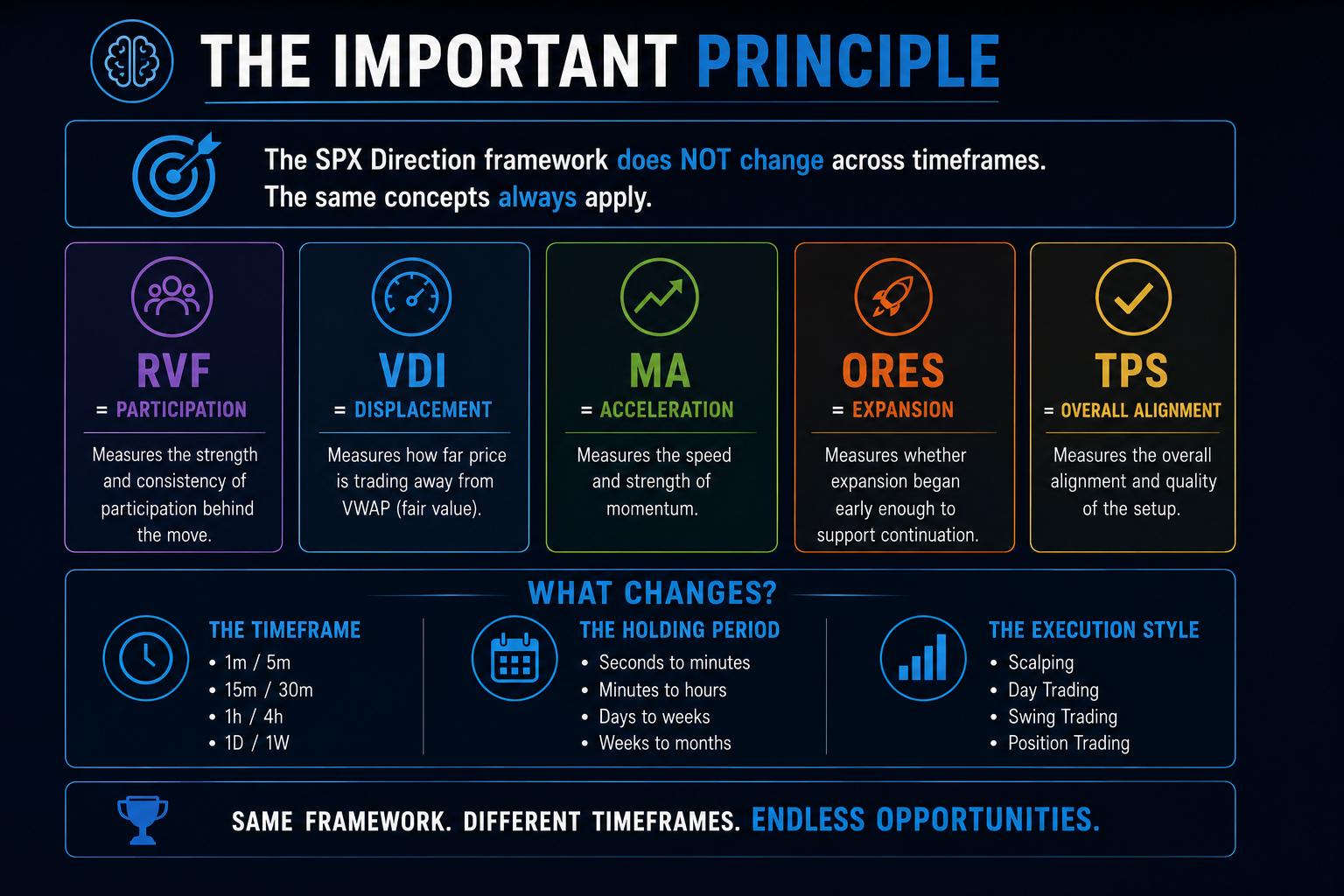
🧠 THE IMPORTANT PRINCIPLE
The SPX Direction framework does NOT change across timeframes.
The same concepts always apply:
- RVF = participation
- VDI = displacement
- MA = acceleration
- ORES = expansion
- TPS = overall alignment
What changes is:
- the timeframe
- the holding period
- the execution style
🧠 FINAL TAKEAWAY
SPX Direction is not built for only one type of trader.
The framework adapts across:
- scalping
- intraday trading
- swing trading
- positioning trading
The parameters remain universal because markets always move through the same core mechanics:
- participation
- displacement
- momentum
- expansion
Only the timeframe changes.