Introduction to ES Probability Parameters - RVF, VDI, MA, ORES & the Combined TPS
Contact customer support at support@spxdirection.com
ES Probability Parameters
SPX Direction monitors the market’s direction, analyzes underlying conviction and acceleration, and helps members achieve precise execution with the tools on the member dashboard.
An important subset of our algorithm are the 4 probability parameters and their ‘aggregated score’, all of which are calculated in real time during regular trading hours (9:30 am to 4 pm EST on trading days).
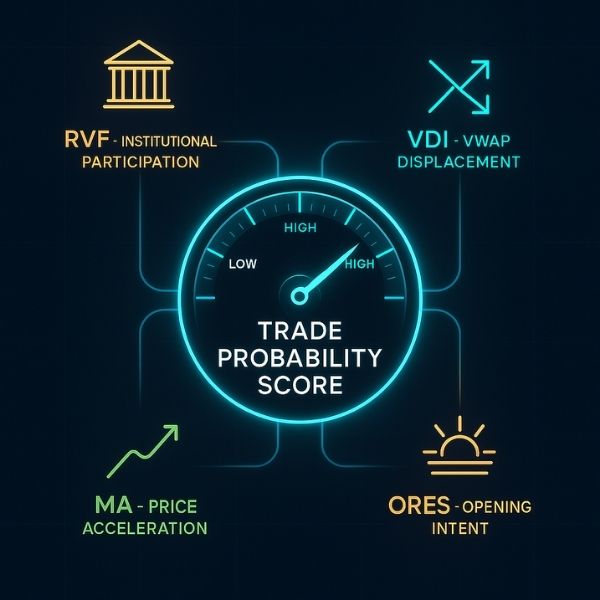
Our 4 probability parameters are RVF (conviction), VDI (direction), MA (acceleration) and ORES (origination), all of these are combined into a “Trade Probability Score” (execution).
- RVF → institutional participation
- VDI → displacement from VWAP
- MA → price acceleration
- ORES → opening intent
- TPS → Trade Probability Score → execution signal (combines all of the above)
These parameters have been designed for ES (and by extension SPX / SPY). In future updates, these will be rolled out for the MAG7 stocks individually, but please note the recommended thresholds will be slightly different for ES relative to individual stocks. Each of the individual MAG7 stocks (AAPL, TSLA, MSFT, META, NVDA, AMZN, GOOGL) behave differently relative to ES.
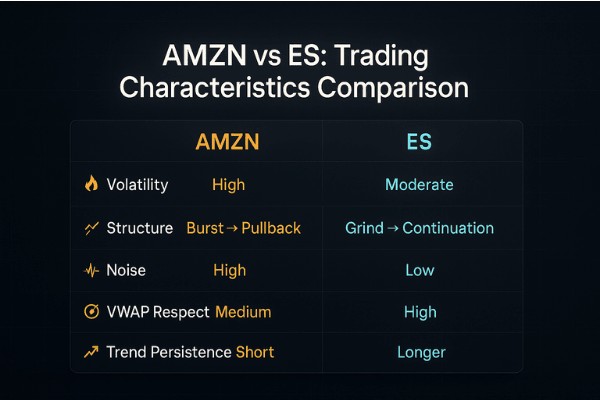
When applying our parameters from ES to stocks, the framework will transfer, the thresholds will not. Here’s the difference between intraday movements of individual stocks (like AMZN) relative to the ES.
|
Feature |
AMZN |
ES |
|
Volatility |
High |
Moderate |
|
Structure |
Burst → pullback |
Grind → continuation |
|
Noise |
High |
Low |
|
VWAP respect |
Medium |
High |
|
Trend persistence |
Short |
Longer |
⚠️ What must change (critical)
ES moves:
- Slower
- Cleaner
- With less extreme displacement
So your thresholds must be tighter and lower.
For E-mini S&P 500 Futures (ES), volume is more stable and institutional relative to individual stocks, so the thresholds are tighter and more reliable. In other words, thresholds will be different when using our algorithm for individual stocks. Compared to stocks, ES has consistent baseline liquidity, moves are driven by macro new + systematic flow, and random volume spikes as seen in individual stocks are less likely. A move from 1.00 → 1.12 RVF is meaningful in ES but not in an individual stock. ES doesn’t need high RVF — it needs consistent and increasing RVF.
Understanding these principles helps SPX Direction members to turn numbers on our dashboard into actionable trades and avoiding traps. Our parameters help you identify sustained imbalance + institutional participation. SPX Direction members do not trade any individual parameter in isolation. They trade regimes created by combinations of scores around key institutional levels.
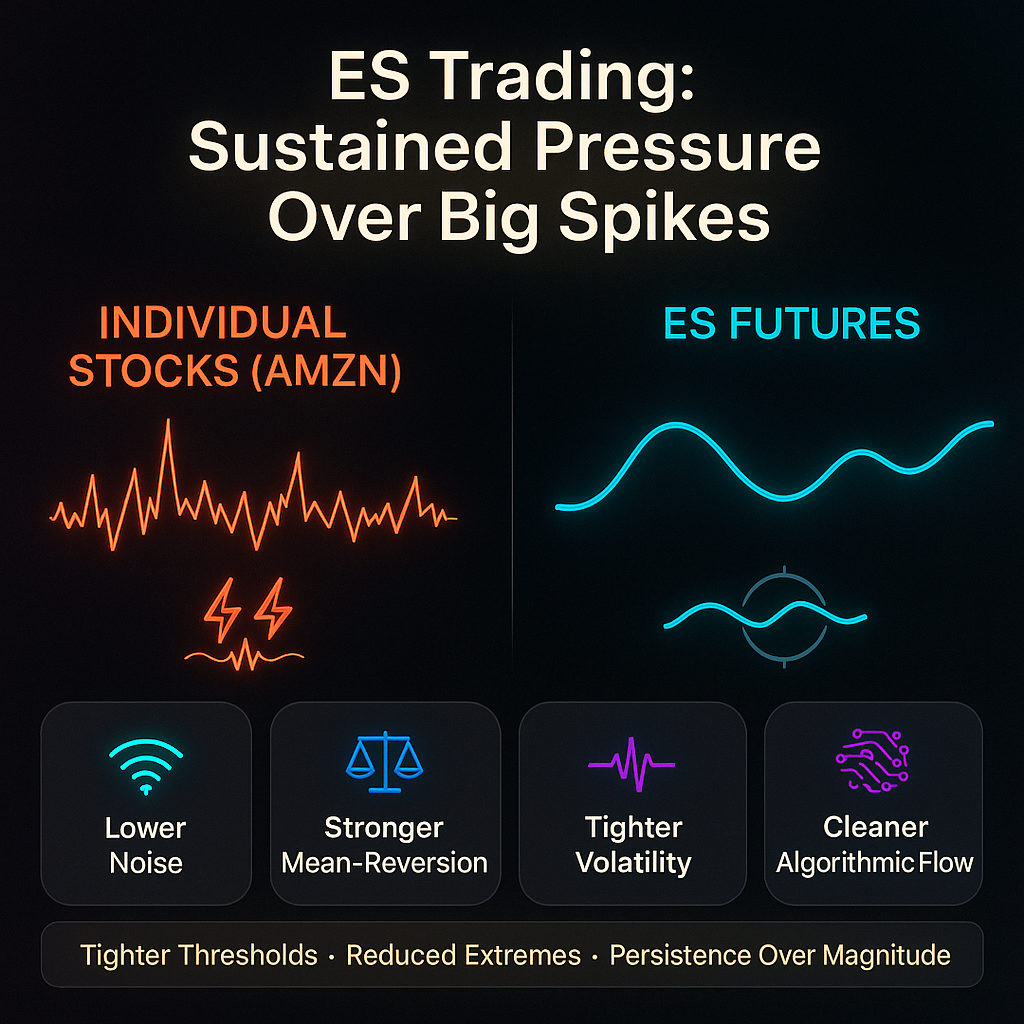
For ES, you don’t need big spikes unlike individual stocks - you need sustained pressure. Trading E-mini S&P 500 Futures (ES) using our dashboard is different from trading individual stocks like AMZN because of:
- Lower noise
- Stronger mean-reversion tendencies
- Tighter volatility distribution
- More algorithmic flow → cleaner thresholds
So we tighten thresholds, reduce extremes, and emphasize persistence over magnitude.